
Speech by David Holt, Mayor of Oklahoma City and President of the National Council of Mayors
On receiving the Howard H. Baker, Jr. Award for Public Service at the University of Tennessee
November 14, 2025
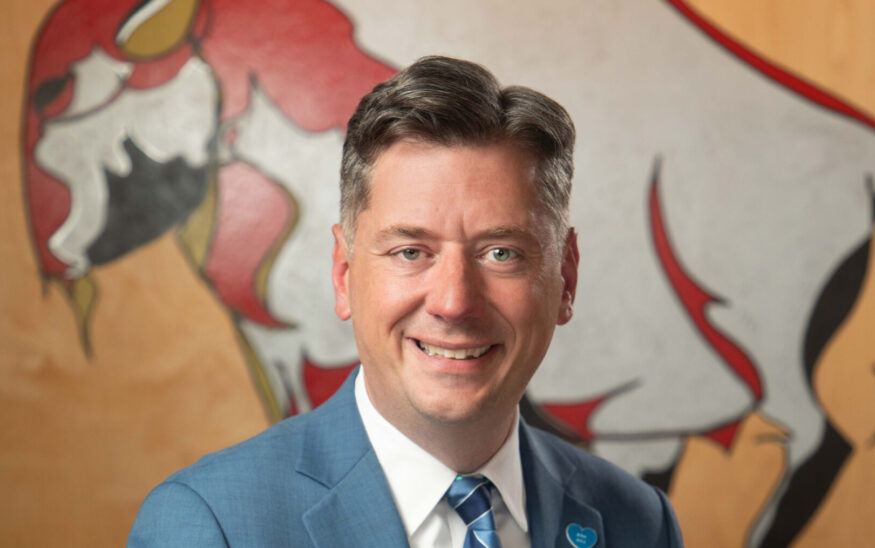
First of all, thank you for the hospitality from everyone connected with the Baker School, and for this incredible honor. It was a complete surprise when Dean Wanamaker reached out last Fall, and I want you to know how meaningful it is to be acknowledged in this way. It is vitally important at this moment in our nation’s history to encourage public servants who model the style of public service embodied by United States Senator Howard Baker. And so I am personally grateful for this validation and encouragement, but even more grateful that this award now exists and that it will be bestowed upon others in the years to come.
In accepting this award, I have been asked to share a few thoughts, and I appreciate the opportunity to do so. Certainly, I want to speak this evening of the ideals for which I believe Senator Baker stood.
There are many ways to reference the American form of government. Personally, I am fond of “the American experiment.” I like this phrase because calling it an experiment reminds us that what we have created here in the United States is an outlier in human history. Across the span of thousands of years of recorded civilization, most humans have lived and do live in some form of autocracy. Even today, less than half of the humans living on this planet reside in a nation that can even claim to be running some version of a democracy. As residents of this great nation, there is nothing in our literal DNA that assures us this form of government. It is only made possible by intentional cultivation of our civic DNA.
Many people assess the autocratic societies around the world through the lens of personal freedom, or its lack thereof, and that absence of personal agency is also obviously accompanied by a lack of collective agency. Most humans have lived and do live in situations where there is no peaceful recourse to alter the direction of their society. Most people outside of the United States don’t have a clear path forward for changing policy through advocacy and persuasion, or elections. Change does inevitably come, of course, but it typically comes through violence. In most societies, violence is the only way to resolve conflict, it is the only way to make change, it is the only way to win an argument, and to the extent words are utilized, they exist to inspire collective violence. In America, since 1796, regime change has meant a presidential election. In most other places, it means trauma, tragedy and death.
And so, the American experiment is an outlier in human history is that it provides us an outlet to make change without violence. If I could distill the entire American experiment down to one purpose, it is that. The American experiment, the American form of government, is an alternative to violence. And of course, I’m well aware that even with that option, Americans have occasionally still fallen back upon their most unfortunate human instincts. Civil War battlefields and the memorial in my city are testaments to that. But to date, we have always recovered from those challenges. The Republic has survived, as Senator Baker might say.
But here in 2026, in the aftermath of January 6th, amidst bitter partisanship, the continued breaking of established norms, misinformation and conspiracy theories, a general lack of seriousness in governance and an abundance of vulgarity in the nation’s political life, it does feel as if we are facing another of those challenging moments.
As such, it is a fitting time to revisit some foundational principles. These principles I will touch upon this evening are not necessarily written in our founding documents. This experiment has endured not just because we have kept the Constitution hermetically sealed in a case at the National Archives. Our experiment has endured because of a shared commitment by public servants, voters and citizens to behaviors that are largely unwritten. And the only enforcement mechanism is a common understanding that the experiment will otherwise collapse if these democratic behaviors are neglected. And so we live in such a time where these principles must be articulated again, and if Senator Baker were still with us, I believe he would do so.
In my own words, but aided by some of Senator Baker’s, I’d like to share five principles as I see them. If there were a title to this how-to manual to sustain the America experiment, it would be the simple but profound wisdom captured in Senator Baker’s statement that “the other fellow may be right.”
My first principle is that pluralism is inescapable, it cannot be extinguished, and no attempt should be made to do so. Any such effort will only be met with disappointment and gridlock.
Pluralism is a word that feels a bit too political science-y. But we need to talk more about pluralism. Pluralism is the reality that there will always be many different worldviews, experiences and ideologies in a nation of over 340 million Americans. We will never be homogenous in our views, we will never all be persuaded to one philosophy, and that’s okay. It has to be okay, because it simply is.
We can and should attempt to persuade others of our views, but we should never see ourselves as warriors in a new crusade, sent to convert or destroy. We will never all see everything the same way, and so pluralism is a constant no less powerful than gravity.
It is implicit in Senator Baker’s turn of phrase about the “other fellow” that the “other fellow” has a different view, and it’s apparently not changing, despite the Senator’s best efforts. So what do we do then?
Well, this leads to my second principle, and that is that if pluralism is a constant, then we have no choice but to accept compromise.
It is fashionable these days to portray our ideological differences as a threat to our experiment. This is a red herring. Our system assumes policy differences. Our system is not built for a homogenous nation, it is built for pluralism.
Our ideological differences are only a problem if we will not accept compromise. The Great Conciliator, as Senator Baker was known, certainly accepted compromise. Senator Baker once said, “It is the resolution of conflict… that makes the difference between successful self-government and civil warfare.”
As I said earlier, the American political experiment is an alternative to violence. In the violent resolution of conflicts, the allure, I suppose, is that one of us will achieve total victory. But compromise achieves a different, more nuanced outcome, and in an ideal compromise, both sides achieve at least partial victory.
The American political system offers the mechanism for arriving at this fair and reasonable outcome. There are opportunities for feedback, at election time and throughout every step of the decision-making process. And in that process, different factions are forced to work through their differences in legislative bodies, usually subject to approval from a broadly elected executive, and bound by the rule of law, as enforced by a judicial system.
This thoughtful process delivers outcomes that are good enough. That’s the best-case scenario. Almost no one is likely to say that the outcome is perfect. But virtually everyone is going to see some of what they wanted in the outcome. And a good compromise is probably going to leave about 70 percent of people saying that it was good enough. That’s a consensus in American politics.
Of course, there will always be people who will say that good enough is not good enough. That’s the 15 percent at each extreme, and that collective 30 percent isn’t part of the consensus. That 30 percent tends to be those who are both extreme in their ideology and their approach. We have to watch out for them, because they would have us kill each other. We have to be brave enough to say to them that good enough is good enough.
In Oklahoma City, where I come from, we get things done relentlessly, and to do so, we accept good enough, and we embrace compromise. Let me share an example. I became mayor in 2018. By that point, our city was already in a renaissance, largely fueled by an initiative known as MAPS. MAPS stands for Metropolitan Area Projects and it is a one-cent temporary sales tax that invests in quality-of-life infrastructure. We passed previous MAPS initiatives in 1993, 2001 and 2009. When I took office in 2018, it was time to develop a new MAPS and present it to the voters. It was universally believed that successful passage of another MAPS package was critical to continuing our city’s momentum. Being the fourth iteration of this initiative, this MAPS would be known as MAPS 4. We are numbering them like a movie series at this point.
MAPS 3 had passed in 2009 with just 54 percent, so it wasn’t necessarily the case that success was preordained. And frankly, I was a little concerned about complacency. MAPS is a tax and people will always find reasons not to vote for a tax. Perhaps after all these years, they would say that it was time to move on. So I made the development of MAPS my life’s work for the first 18 months of my mayoral tenure.
First, we launched the MAPS 4 process with a public campaign to accept ideas, and we received thousands. Then we narrowed those to 16 proposals. Then we held nearly 25 hours of public hearings at City Hall and invited anyone and everyone to come and speak on those 16 proposed projects. We listened more often than we spoke, as Senator Baker suggested in a quote displayed right outside this room.
And then having spent a year listening to how the people of Oklahoma City wanted to move forward with a new MAPS initiative, I finally sat down and crafted the package.
MAPS 4 would be one vote by the people of Oklahoma City, up or down. I ultimately decided I wanted to include all 16 projects that had emerged as finalists, but they did not collectively represent a unified world view. Some projects were more focused on economic development, like a new arena at our fairgrounds to continue attracting horse shows, a soccer stadium to maintain and expand the sports and entertainment events we could host, and investments in what we call our city’s Innovation District. Those projects were generally attractive to people you might think of as on the right side of the political spectrum. Other projects were more attractive to people you might think of as on the left side of the political spectrum. Those included a museum telling our city’s civil rights story, mental health crisis centers, new transit options, and housing for the homeless.
Only the mayor liked all 16 projects. But even if most residents would tell you they didn’t like some of the projects, most of them liked enough of the projects to vote yes. In its totality, the MAPS 4 proposal was a classic compromise.
I very intentionally set out to create a package that would be good enough for a broad spectrum of the electorate. I did not set out to create something that was perfect for any one group. This kind of compromise has become so foreign to many Americans that some people were suspicious. Some accused me of just trying to please everyone, to which I said, “Yes, that’s my job!” And so I presented the entire MAPS 4 package to the voters of Oklahoma City in late 2019, and it got 72 percent approval, the largest margin of support in city history for a sales tax.
Since then I’ve presented many more compromises to my voters. An arena package in 2023 for $1 billion to retain the NBA in OKC that got 71 percent. A $2.7 billion core infrastructure package in 2025 that was actually nearly a dozen different votes, with support ranging as low as 75 percent and as high as 85 percent. And then just two months ago I presented the compromiser himself for my quadrennial review, and on February 10th, I was re-elected to a third term with 86.5 percent of the vote.
Now, let me explain something interesting about Oklahoma City that may surprise you, based on the monolithic election results I just described. We are very diverse in every way. We are an almost perfect microcosm of the country, politically and demographically.
In 2020 and 2024, in the county that encompasses most of Oklahoma City, the Republican for President beat the Democrat for President 49-48. That was the exact same margin in both 2020 and 2024. That’s basically 50-50, just like the country. And our demographics also mirror the country. We are about 14 percent African American and 20 percent Latino. And yet, unlike the country, we are passing initiatives and electing candidates with 71, 72, 85, 86 percent of the vote. Republicans, Democrats and Independents are coming together and voting the same way on the same day in Oklahoma City.
Why? Because we are listening to each other, incorporating elements of everyone’s preferences in the outcome, and then we’re compromising. We are a living case study that the political process doesn’t have to be polarizing, and it doesn’t have to be winner-take-all. In OKC, we accept that the other fellow might win as well. We have to be okay with that. We can’t be so scorched earth in our approach that we are almost more focused on withholding success from others than we are our own desires. We must be willing to arrive at outcomes where everybody wins a little.
And in our candidate electoral process in Oklahoma City, candidates like myself are rewarded for this behavior. We are incentivized to bring people together. When I run for mayor, I do not run through a closed partisan primary. This is pretty common in mayoral systems around the country, but it is obviously not how state and federal officials are elected. Those candidates generally have to go through a closed partisan primary, where a small, extreme and uncompromising subset of the electorate acts as a gatekeeper.
But when you run for mayor of Oklahoma City, all of the candidates have to face all of the voters, and all of the voters get to see all of the candidates. This incentivizes mayors to build coalitions of the 70 percent of people in the middle. And as it turns out, that 70 percent still believes in compromise. Americans are not polarized. Some of us are; the 15 percent at each end of the spectrum. And unfortunately, through closed partisan primaries, they control who represents us. But the reality is that there are 70 percent of us in the middle – Republicans, Democrats and Independents – who just want to get things done. We have proven that out in Oklahoma City.
This leads to my third principle, and that is that we must communicate to our public servants that we understand the need to compromise, and that a willingness to compromise does not mean you have abandoned your values.
Our American experiment only works when it works. It has to produce outcomes. Senator Baker once said that his greatest legacy as Senate Majority Leader was that “this place works.”
Leaders who want things to work have to accept compromise. And leaders who accept compromise are sometimes mistakenly called moderates. I have no problem with moderates, but accepting a compromise does not necessarily mean you are a moderate; it means that you wish to be effective.
Compromise is how you effect your desired change. Pragmatism is not an ideology, it is a tactic. We must communicate better so that we understand this. We must assess our leaders and representatives with at least two different measurements – their ideology and their approach.
It was often noted by supporters and opponents alike that Senator Baker was sometimes described as a moderate Republican when in reality he consistently voted like a conservative Republican. One senator noted that Senator Baker and Senator Barry Goldwater would take the same position and that somehow Senator Baker would come off looking like a statesman and Senator Goldwater would come off looking like a stubborn ideologue. I suspect this was because of their different approaches to compromise. Observers knew Senator Baker would work the American political process to effect some change, even if it was less than he originally desired. And they knew Senator Goldwater likely would not.
An uncompromising stance never yields any outcome at all in a democratic system like ours. It is folly for us to reward that kind of behavior. And yet we live in a time when candidates for public office love to tell you that they will fight for you. They very rarely state any more in their commercials that they will work across the aisle to get things done. They will instead ask you to “send a fighter to Washington.” There is very little about the American political system that rewards fighting. Show me a fighter and I will show you a legislative failure.
Now, sure, debate vigorously, work hard, articulate your principles, attempt to persuade, but at some point, you’re going to have to sit at a table with people who have a different worldview, and you’re going to have to give up something to get something. You can fight, but not to the death.
An uncompromising approach is ascendant right now at the federal level, and so what do we see? We see gridlock. No real progress, just Tweets and press conferences. Nothing happens, and when nothing happens, the public pines for autocracy, because it gets things done. They forget that once they give up their freedoms and their agency in exchange for efficiency, they never get those things back. We have to start compromising again, and we have to tell our leaders and our representatives that it is okay to do so, in order that our systems might work again.
Senator Baker was first a conservative and second, he was a willing negotiator. This acknowledgment of the realities of our system made him infinitely more effective, but it did not make him a moderate. To hold conservative or liberal philosophical principles and to be moderated in your approach is not a contradiction. We have to better understand this duality, so that we may better incentivize and direct our elected officials.
My fourth principle is that we each have to respect the basic humanity of our fellow Americans. If we are acknowledging pluralism and encouraging compromise, we are inherently accepting that everyone’s opinion counts equally. That respect is also manifested through civility towards our fellow Americans. This civility was intrinsic to Senator Baker’s ethos. Senator Baker once said “… if we cannot be civil with one another – if we stop dealing with those who disagree with us or those we do not like, we would soon stop functioning altogether.”
Mayors understand this. I currently serve as President of the nation’s mayors. Because of that, the leadership of our organization gathered in Oklahoma City in September, just a couple weeks after the high-profile murder of Charlie Kirk. That murder had followed a series of other violent acts and murders of public officials of both parties across the United States.
That day in September last year in Oklahoma City, about 50 of us mayors gathered at the Oklahoma City National Memorial, the site of the deadliest act of political violence in living memory. At a federal office building in downtown Oklahoma City, on April 19, 1995, a veteran of our military planted a truck bomb and killed 168 of our residents. Today, there is a moving memorial there, and one key element is the Survivor Tree, a tree that survived the Bombing and came back stronger than ever. Under the Survivor Tree, the mayors signed the Oklahoma City Declaration.
The Oklahoma City Declaration was something that I sat down and wrote the night before our meeting. It’s a two-page document that rejects political violence and positions pluralism, compromise and persuasion as key elements of our democratic experiment. And it presents a series of practical beliefs we as mayors are committed to. I’d like to share them with you today, just as they are written in the Declaration.
In the Oklahoma City Declaration, we mayors stated we believe that:
“… political violence in any form is unacceptable and should be met with the harshest condemnation and penalties. We will condemn those who use or condone political violence, and will seek full accountability for their actions, even if their political position was one with which we agreed.”
We stated “That even in a pluralistic society, those things we have in common still far exceed those things that make us different. We will seek ways to inject our shared humanity into debates, even when those debates are emotional (especially when those debates are emotional).”
We stated that “That civility matters, because it is a reflection of our respect for our shared humanity. We will refrain from referring to those with whom we disagree by anything but their preferred name, and if they have a title, we will use it.”
We stated “That dehumanization is the rhetorical device that has paved the way to the worst atrocities in human history. We will refrain from referring to those Americans with whom we disagree as ‘enemies’ or as ‘evil’ or with terms that imply they are less than human in any way.”
We stated “That we each deserve to be treated as individuals. We will refrain from imputing the actions or statements of one person or group to everyone we perceive to be in agreement with that person or group’s political positions.”
We stated “That there is no issue within the confines of the American experiment – outside of insurrection or war – that is truly existential, and we will refrain from apocalyptic political rhetoric.”
We stated “That truth matters, especially when false information contributes to unnecessary outrage and emotion. We will refrain from spreading false information and will correct and condemn the spread of false information, even when it originates from a person or group whose position is one with which we agree.”
We stated “That everyone participating in the American experiment is motivated by the same thing – a better life for all of us. Unless there are serious allegations to the contrary, we will refrain from questioning the personal motivations of those with whom we disagree.”
I would add here as an aside today that Senator Baker once said that “it ill behooves America’s leaders to… inveigh carelessly against motives and morals of one’s political adversaries.”
Continuing with the Declaration, we mayors stated “That not every thought has to be expressed out loud, especially on social media. We will use social media responsibly and with restraint.” I would add here that Senator Baker once quoted his father-in-law, Senator Everett Dirksen, who said “Occasionally allow yourself the luxury of an unexpressed thought.”
And finally, to conclude the Oklahoma City Declaration, America’s mayors stated “That we are humans first, Americans second, and partisans last.”
Since that time, over 230 bipartisan mayors have now signed the Oklahoma City Declaration, including Mayor Indya Kincannon of Knoxville.
My fifth and final principle today is that truth and morality have to be at the core of our experiment, or it collapses under the weight of its own dishonor and corruption.
Senator Baker once said “Tell the truth, whether you have to or not.” The moral clarity of that statement is so profound. We must adhere to the truth even when it seems unnecessary. Why? Because we will eventually pay a price when Americans can no longer trust that we care about the truth.
On this point I have no greater example than Senator Baker’s courageous oversight of the Senate’s Watergate investigation. As his Democratic colleague on the Watergate committee, Senator Sam Ervin, would later say, Senator Baker “gave primacy to his country and to his duty to ascertain what the truth was.” Ervin added that Baker placed his “loyalty to the country” above his loyalty to the Republican Party.
These five principles I have attempted to articulate this evening are really mere echoes of observations made for generations about our American experiment. You can look to de Tocqueville or Senator Baker himself for even greater wisdom. I am merely attempting to communicate these principles to a modern audience in need of accessible reminders.
One American who did not need any such reminders was of course Senator Baker. Senator Howard Baker was a statesman who understood these principles deeply. He articulated them well throughout his life. Senator Baker once described the greatest senators in our history as those who brought “principled courage, creative compromise and persuasive eloquence.” He articulated those qualities and he lived those qualities. We ignore his words and his example at our peril.
I’ll close with that word I just used to describe Senator Baker – statesman. Personally, I think it is the highest honorific I can bestow upon an American public servant. It carries with it all the best connotations. Within itself, it communicates the most important concept of all. You are the best public servant and citizen when you put the state and its people before the man or woman who serves. I’ve said over 4,000 words just now, but if we can each simply remember the pursuit of that one ideal – to be a statesman – we will further Senator Baker’s legacy, and more importantly, we will fulfill our obligation to pass this American experiment on to the next generation, so that the Republic may endure.
Thank you.